BNS 80
BNS Section 80,
Dowry Death.
The gravest of the dowry offences, and the only one where the law presumes guilt once the prosecution clears a threshold.
Section 80 of the Bharatiya Nyaya Sanhita is the dowry death provision. It replaced IPC 304B on 1 July 2024 and carries seven years to life.
If a woman dies unnaturally within seven years of marriage and there is evidence of dowry harassment before her death, that is a dowry death.
Once the prosecution establishes those ingredients, the law presumes the husband or his relative caused the death. They have to disprove it.
What the section says
Dowry death
Where the death of a woman is caused by any burns or bodily injury, or occurs otherwise than under normal circumstances, within seven years of her marriage, and it is shown that soon before her death she was subjected to cruelty or harassment by her husband or any relative of her husband for, or in connection with, any demand for dowry, such death shall be called a dowry death, and the husband or relative shall be deemed to have caused her death.
This replaced IPC Section 304B on 1 July 2024. As with Section 85, the substance carried over and only the number changed. Cases registered before that date continue under 304B.
The four ingredients
Every one of these has to be established. They are worth listing separately because prosecutions fail on the third and fourth far more often than the first two.
- The woman has died. By burns, by bodily injury, or otherwise than under normal circumstances. That last phrase is deliberately wide and is what brings in deaths recorded as accidents or suicides.
- Within seven years of the marriage. A hard limit.
- She was subjected to cruelty or harassment by the husband or his relative.
- That cruelty was for, or in connection with, a demand for dowry, and it occurred soon before her death.
What "soon before" means
The statute does not define it, and courts have declined to fix a period. What they have said is that there must be a live and proximate link between the harassment and the death, rather than a stale allegation about something years earlier. A pattern of continuing harassment satisfies it. A single incident long past generally does not.
Why the dowry connection is essential
Satvir Singh v. State of Punjab
The cruelty has to be connected to a dowry demand for the section to apply. Cruelty in a marriage that has nothing to do with dowry, however serious, falls outside Section 80. It may still be an offence under Section 85 or, if the facts support it, murder.
The presumption, and why it exists
Presumption as to dowry death
Where a question arises whether a person has committed a dowry death, and it is shown that soon before her death the woman had been subjected to cruelty or harassment for or in connection with a demand for dowry, the court shall presume that the person caused the dowry death.
Reversing the burden of proof is a serious thing to do in criminal law, and Parliament did it here for a specific reason. In a dowry death the only witnesses are usually the people accused, the death occurs inside the home, and the physical evidence is under their control. Requiring the prosecution to prove what happened in a kitchen with no independent witness would have made the offence unprosecutable.
The presumption is not automatic. It arms itself only after the prosecution has proved the ingredients. It is also rebuttable: the accused can displace it with evidence.
The scale of it
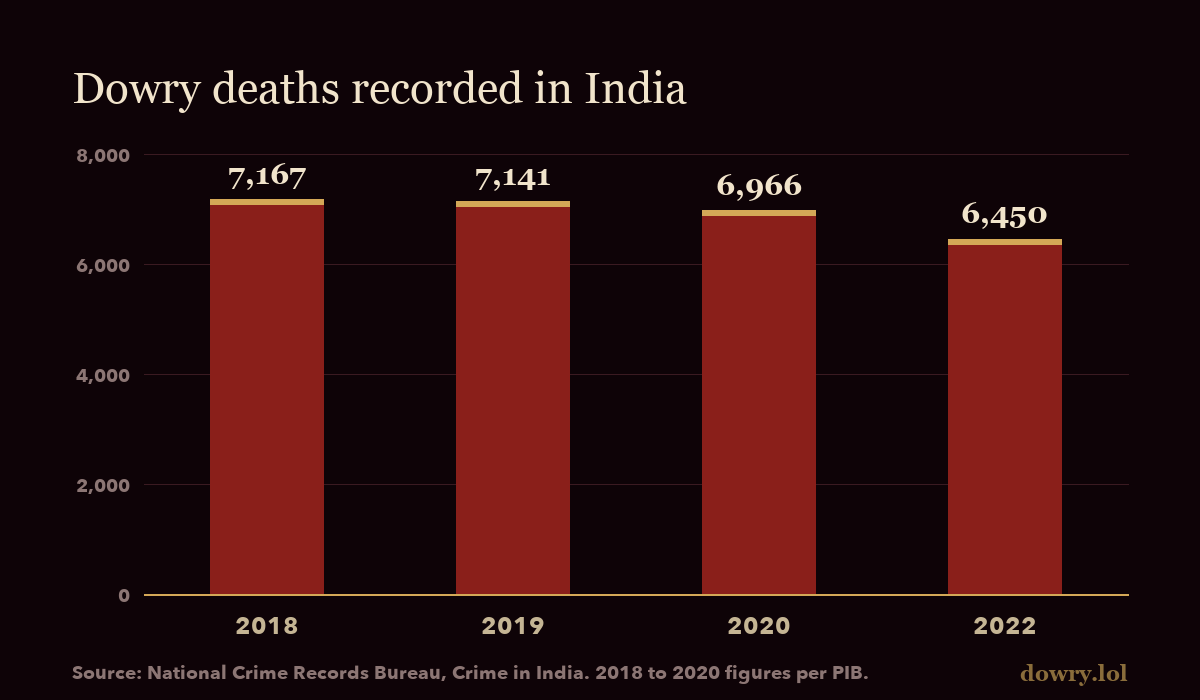
What tends to go wrong in these cases
Conviction rates in dowry death cases sit far below the number of cases registered. The reasons are documented and mostly procedural rather than legal.
- The scene is compromised. Deaths by burning in a domestic kitchen leave evidence that degrades quickly and is easily explained away as an accident.
- Dying declarations are contested. They are often the strongest evidence available, and their reliability is litigated hard.
- Witnesses are family. The people who could testify to the harassment are frequently related to one side or the other, and turn hostile.
- Delay. Trials running for years lose witnesses and detail.
None of this is a reason not to report. It is a reason to report early, in writing, and to keep records of demands as they are made, which is exactly what makes the "soon before" element provable later.
If you are being harassed for dowry right now
Related reading
- BNS 85, cruelty and harassment →
- How to file a complaint →
- Dowry statistics in India →
- Key court judgments →
Sources
Common questions
What is dowry death under Indian law?
Under Section 80 of the Bharatiya Nyaya Sanhita, 2023, formerly Section 304B of the Indian Penal Code, a dowry death occurs where a woman dies by burns, bodily injury or otherwise than under normal circumstances within seven years of her marriage, and it is shown that she was subjected to cruelty or harassment by her husband or his relatives in connection with a demand for dowry. The punishment is imprisonment of not less than seven years, extending to life.
What is the punishment for dowry death?
Imprisonment of not less than seven years, which may extend to life imprisonment. There is no provision for a fine in place of the custodial sentence and the seven year floor is a genuine minimum.
What is the seven year rule in dowry death?
Section 80 applies only where the death occurs within seven years of the marriage. The window exists because dowry harassment and the violence that follows it statistically cluster in the early years of a marriage. A death after seven years is not a dowry death under Section 80, though it may still be prosecuted as murder or abetment of suicide.
Who has to prove a dowry death?
The prosecution must first establish the ingredients: an unnatural death within seven years of marriage, and cruelty or harassment connected to a dowry demand. Once those are established, Section 118 of the Bharatiya Sakshya Adhiniyam, 2023, formerly Section 113B of the Evidence Act, requires the court to presume that the accused caused the dowry death. The burden then shifts to the accused to rebut it.